

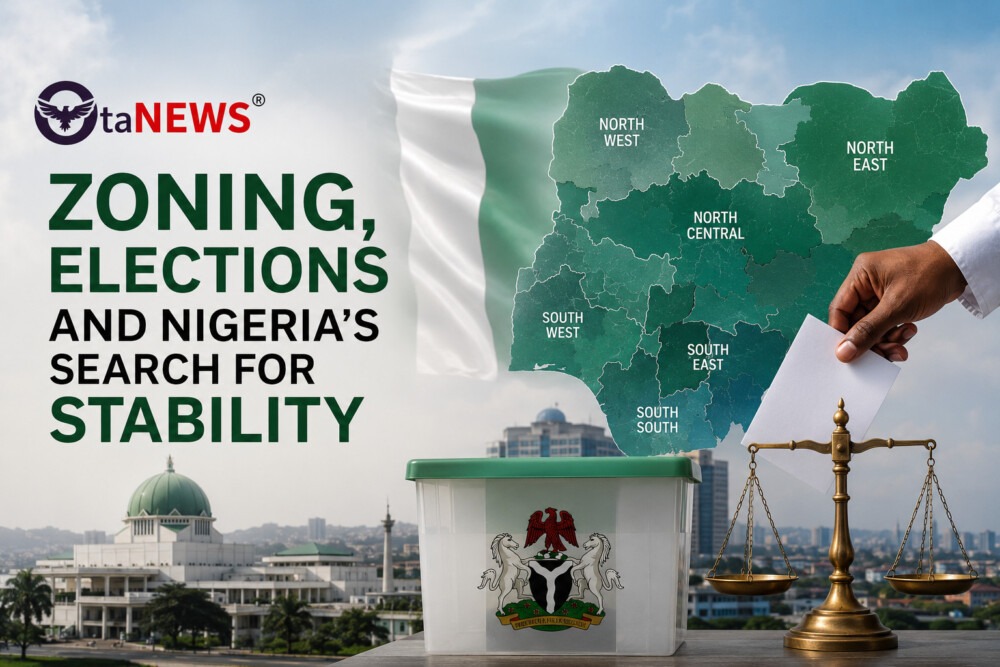
Zoning, Elections and Nigeria’s Search for Stability
Nigeria’s debate on zoning and power rotation often becomes emotional. But it helps to step back and ask a precise question: what specific problem are we trying to solve?
There are two distinct problems. First, how do we reduce the post-election disunity that has repeatedly fractured the country along ethnic and regional lines? Second, how do we ensure that every Nigerian — regardless of the size of their ethnic group — has a realistic pathway to the presidency?
The Real Problem: Post-Election Disunity
When we look at Nigeria’s most turbulent electoral periods, the common thread is not simply violence. It is sustained national disunity that persists long after the votes are counted. This disunity has a specific and identifiable cause: when candidates come from different major ethnic groups, a loss by any one candidate is not experienced merely as a political defeat. It is experienced as a group defeat — a signal to an entire community that they have been shut out of power and the resources that come with it.
In Nigeria’s federal structure, where control of the presidency determines how oil revenues and national resources are allocated, this is not paranoia. It is a rational reading of how the system works. When a community believes its group has lost access to power, resentment does not dissipate after the election. It compounds — layering across election cycles, feeding separatist sentiment, and corroding the sense of shared nationhood.
A number of election cycles illustrate this pattern clearly:
- 1964/65 (cross-regional contest) → coup, counter-coup, and civil war
- 1983 (Shagari/Awolowo/Azikiwe) → military intervention
- 1993 (Abiola/Tofa) → annulment and prolonged national crisis
- 2003 (Obasanjo/Buhari) → deep post-election tensions, particularly in the North
- 2015 (Buhari/Jonathan) → a near-crisis moment, defused only by Jonathan’s personal decision to concede
- 2023 (Tinubu/Obi/Atiku) → persistent, multi-zonal divisions that have not fully healed
The argument here is not that cross-regional contests directly cause crises. Other factors — institutional weakness, economic conditions, and the behaviour of political elites — also play important roles. But highly competitive contests between candidates from the three dominant ethnic blocs consistently amplify fault lines in ways that same-zone contests do not.
The 1999 election between Olusegun Obasanjo and Olu Falae is particularly instructive. Both candidates were Yoruba. The Yoruba voted heavily for Falae; the rest of the country largely voted for Obasanjo. Falae lost. The Yoruba were not entirely happy — but they accepted the outcome and the country moved forward with a degree of cohesion that cross-regional contests have rarely produced.
Why? Because Yorubas knew that a Yoruba was at the table regardless. The communal stake in the outcome was fundamentally different. The contest was, in effect, an internal affair. No other region felt threatened, and the losing community felt represented even in defeat.
This is the psychological and political insight at the heart of the zoning argument: Nigerians are more concerned with knowing that their group has a seat at the table than with who specifically from their group occupies it. Intra-group loss is survivable. Inter-group loss, in a winner-takes-all federal system, frequently is not.
The 2007 election, where both leading candidates — Yar’Adua and Buhari — were Northerners, also proceeded without the kind of inter-regional disunity typical of cross-regional contests, despite serious credibility questions about the process itself. No southern zone felt that a northern victory constituted their exclusion, because the broader zoning arrangement signalled that their turn would come.
Beyond managing disunity among the three major groups, there is a second and equally important objective: ensuring that smaller ethnic groups have a genuine pathway to the presidency.
Under open competition, this pathway is practically closed. A candidate from Benue, Ijaw, Kanuri, or any of Nigeria’s hundreds of smaller nationalities faces an insurmountable ethnic arithmetic problem. Their group cannot deliver enough votes.
They must subordinate their identity to attach to a major ethnic group’s political machine. They depend on others’ goodwill rather than a structural entitlement. The result is that Nigeria’s presidency has effectively cycled among three broad ethnic constituencies since independence — not by deliberate design, but as an unavoidable structural outcome of unmanaged diversity.
A rotational system across all six geopolitical zones changes this in a meaningful way. When the North-Central zone’s turn arrives, a candidate from Benue or Plateau State competes on a level playing field against other candidates from the same zone. Their path to the presidency no longer depends on attaching to a Yoruba or Hausa-Fulani vehicle. That is a qualitative improvement in what Nigerian democracy can actually offer its citizens across all of its diversity.
How the Proposed System Works
The proposal is straightforward. From 2031, the presidency rotates among Nigeria’s six geopolitical zones, with each zone producing the presidential candidates for a six-year term before rotation moves to the next zone. Critically, all candidates from the zone are voted for by all Nigerians — not just by voters from that zone. This preserves national democratic participation and ensures the winning president carries a mandate that crosses zonal lines.
What Zoning Does Not Claim to Do
It is important to be precise about what this proposal is and is not. Zoning is not designed to eliminate disunity from Nigerian politics. Given the genuine complexity of Nigeria’s diversity — ethnic, religious, and regional — that would be an impossible promise. What it is designed to do is significantly reduce disunity at the level that has historically posed the greatest threat to national cohesion: contests between the three dominant ethnic blocs for control of the federal presidency.
Zoning also does not resolve the deeper structural issues that make Nigerian elections so high-stakes — the concentration of resource allocation at the federal level, the weakness of independent institutions, or the culture of impunity among political elites. These require their own reforms. But a tool does not have to solve every problem to be worth using. Zoning addresses a specific, identifiable source of recurring national crisis, and it does so in a way that is consistent with democratic principles — provided the intra-zone candidate selection process is genuinely open and competitive.
The Bigger Question
Ultimately, the debate about zoning is a debate about what kind of federation Nigeria wants to be. Open competition, presented as the universal democratic ideal, assumes a level playing field that does not exist in Nigeria’s ethnic and political reality. It produces the appearance of equal opportunity while delivering structurally unequal outcomes — both for the three major groups locked in recurring cycles of contested legitimacy, and for the hundreds of smaller groups who have no realistic path to national leadership at all.
A structured rotation does not suppress competition — it redirects it. Instead of competing over which ethnic bloc controls the country, Nigerians compete over which candidate from the zone in turn can best lead the nation. That is a healthier contest. It is a contest that can produce winners and losers without producing communities that feel permanently excluded.
Whether zoning should be formalised in the constitution, enshrined in electoral law, or adopted as a binding party convention is a question that requires careful national conversation. Reasonable people can disagree on the mechanism. But the underlying principle — that in a country as diverse as Nigeria, stability and equity do not happen by accident, they must be deliberately designed — is difficult to argue against.
©Wale Ogunbanjo

Wale Ogunbanjo is a journalist and contributor to OtaNews