

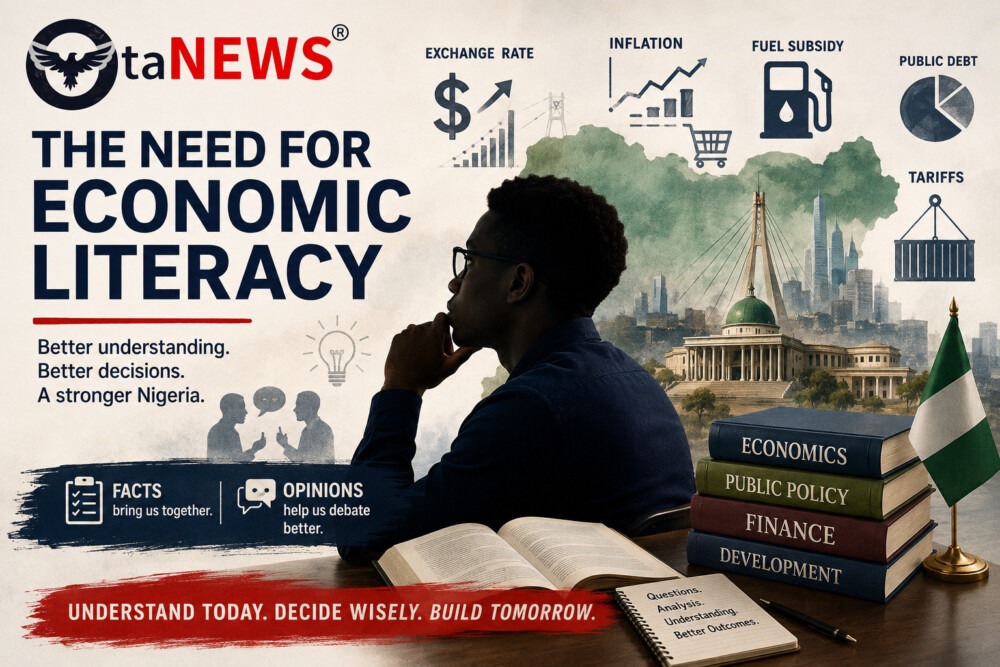
Before We Argue: The Need for Economic Literacy
Separating Fact and Opinion
One striking feature of public debate in Nigeria is not that citizens disagree — disagreement is healthy. The problem is that debates often begin before agreement on basic facts and concepts.
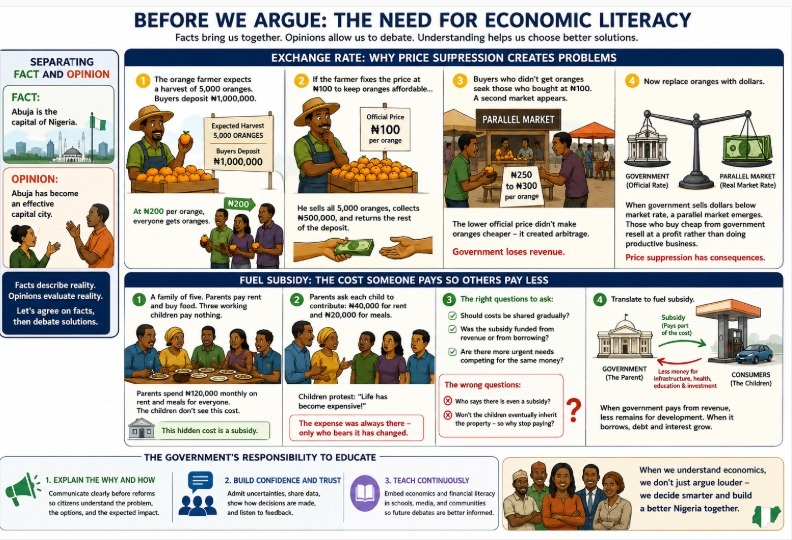
Facts describe reality. Opinions evaluate reality. Confusing the two creates endless arguments.
No two Nigerians should argue over whether Abuja is the capital of Nigeria — that is a fact. But they can disagree over whether Abuja has become an effective capital city — that is opinion. Facts should bring us together around a common understanding. Opinions then allow us to debate alternatives, challenge assumptions, and improve outcomes.
Unfortunately, many economic debates in Nigeria jump straight to judgment while skipping understanding. Concepts like exchange rate, subsidy, inflation, debt, and tariffs are treated as moral questions before they are understood as economic questions. The result: conversations become loud but not enlightening.
Why Economic Literacy Matters
Economic literacy does not require everyone to become an economist. It means understanding enough to ask relevant, well-informed questions — not only for the general public, but also for educated people outside economics who often rely on untested assumptions.
Economic decisions should be judged not by intentions but by the incentives they create and the outcomes they produce.
Consider rent control. A government may fix rents to help low-income citizens. The intention is good. But if developers reduce construction and landlords stop maintaining properties, shortages emerge, informal markets appear, and rents rise in practice. So, although the intention to help low-income citizens by fixing rent is good, it has not led to a good outcome. Good intentions do not automatically produce good outcomes — and bad outcomes do not automatically imply bad intentions.
Understanding economics does not mean agreeing with government. It means understanding what problem government claims to solve before judging whether the solution works.
Exchange Rate: A Debate Many Think They Understand
A common question: “Why did the present government move the exchange rate from around ₦400/$ to over ₦1,000/$?”
Many assume the government deliberately weakened the naira. But economics is rarely that simple.
Let’s use the following analogy of an orange farmer. Expected harvest: 5,000 oranges. Buyers deposit ₦1,000,000. Simple arithmetic gives ₦200 per orange. At ₦200, everyone gets oranges.
But suppose the farmer fixes the price at ₦100 to keep oranges affordable. He sells all 5,000 oranges, collects ₦500,000, and returns the rest of the deposit. Buyers who didn’t get oranges to buy seek out those who bought at ₦100, and soon a second market appears at ₦250 or ₦300. The lower official price did not make oranges cheaper — it created arbitrage – the difference between official and secondary market rates.
Now replace oranges with dollars. When government sells dollars below market rate, a parallel market emerges. Those who buy cheap from government resell at a profit rather than doing productive business. Government loses revenue.
This does not mean government should never intervene. It means price suppression has consequences — and understanding those consequences should come before choosing whether or not to support the policy.
Fuel Subsidy: Mechanics Before Morality
Many Nigerians see subsidy removal as government making fuel expensive overnight. Supporters call removal anti-poor; opponents call subsidy economic sabotage. But first: what is a subsidy? It simply means someone pays part of the cost, so the consumer pays less.
Consider a family of five — parents and three working adult children who pay no rent and eat daily at home. Life feels affordable to the children; their incomes go entirely to personal expenses. But someone is paying the rent and buying the food.
The parents spend ₦120,000 monthly on the children’s share of rent and meals. The children do not see this cost. This cost in an economic sense is subsidy. When the parents announce that each child must now contribute ₦40,000 toward rent and ₦20,000 for meals, the children protest: “Life has become expensive!” But the expense was always there — only who bears it has now changed.
This illustration does not prove subsidy removal is right or wrong. It helps establish a shared understanding and can help ask the right questions: Should costs be shared gradually rather than suddenly? Was the subsidy funded from revenue or from borrowing? Are there more urgent needs competing for the same money?
The wrong questions are: Who says there is even a subsidy? Won’t the children eventually inherit the parents’ property — so why stop paying now?
Translate the analogy to fuel subsidy: government is the parent, consumers are the children, and the subsidy is the ₦120,000 quietly absorbed each month. When government pays it from revenue, less remains for infrastructure, health, and education. When it borrows, debt and interest grow, reducing investment capacity either way.
The Government’s Responsibility to Educate
Economic literacy cannot spread by accident. When governments announce reform policies without explaining the reasoning behind them, the ensuing debate descends into anger and suspicion — citizens are told what will happen, but not why it is necessary or how it is expected to work.
Three things matter here.
First, before major policy changes, governments should explain basic concepts in plain language — on radio, television, social media, town halls, and in school curricula. Citizens do not need economics degrees, but they need to understand cause and effect: “If we fix the price of fuel, here is what historically happens. If we remove the subsidy, here are the trade-offs.”
Second, governments should admit uncertainty and trade-offs openly. No policy is perfect, and pretending otherwise breeds cynicism when imperfections appear. A government that says, “This policy will hurt some people in the short term — here is how we plan to cushion the pain and why we believe the long-term gain is worth it” is far more likely to carry the citizenry along.
Third, governments should fund independent economic education — not propaganda. This means supporting civil society, journalists, and educators to teach economic literacy without political bias. An economically literate public is harder to manipulate but easier to govern well.
Better Understanding, Better Decisions
Citizens should absolutely question government — that is democracy. But citizens also owe themselves the discipline to understand the language of debate.
A citizen who understands economics may still oppose a policy. But the disagreement becomes productive.
Nations do not prosper by eliminating disagreement. They prosper by improving its quality. Nigeria does not need fewer arguments. It needs better ones.
Before we decide who is right, we should first agree on what is true.
