

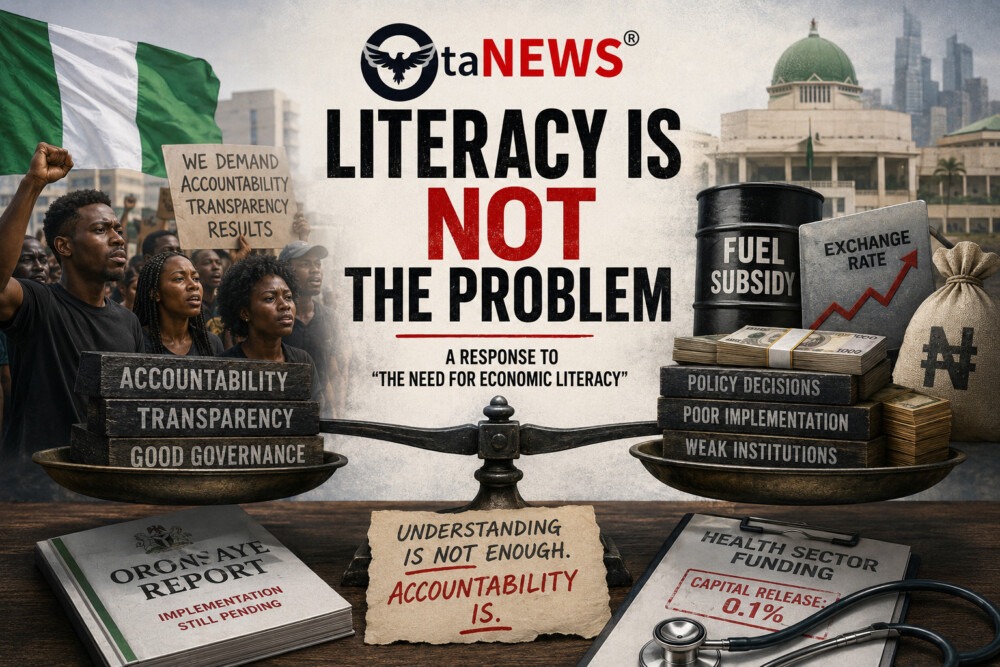
Nigeria’s Problem Is Not Economic Illiteracy, Says Reader
Editor’s Note
Following the publication of Before We Argue: The Need for Economic Literacy by Wale Ogunbanjo, Ota News received the response below from a reader who requested anonymity. Given our commitment to encouraging informed public debate, we have chosen to publish the submission in full.
The author’s central argument is that Nigeria’s challenges are not primarily the result of poor economic literacy among citizens, but of failures in governance, accountability, transparency, and policy implementation. The article disputes the idea that public opposition to policies such as fuel subsidy removal and exchange-rate reforms can be explained mainly by a lack of economic understanding. Instead, it argues that many Nigerians understand the issues well enough but remain dissatisfied with how reforms have been designed, communicated, and executed.
Among other points, the writer questions whether economic concepts can ever be entirely separated from politics, challenges some of the analogies used in the original article, revisits debates around subsidy removal under different administrations, examines government spending priorities, and argues that citizens have legitimate grounds to judge policies by their real-world consequences.
The response is considerably longer than the article that prompted it, but we are publishing it substantially as submitted in the interest of presenting the author’s case in full. Readers are encouraged to engage critically with both articles and draw their own conclusions.
LITERACY IS NOT THE PROBLEM
A Reply to “Before We Argue: The Need for Economic Literacy”
By Anonymous
Wale Ogunbanjo’s essay is well-written, measured, and almost entirely beside the point.
It diagnoses Nigeria’s problem as a shortage of economic literacy among ordinary citizens. It prescribes understanding before argument. It offers gentle analogies – oranges, rent control, grown children eating at their parents’ table – to make hard policy feel intuitive. It is, in the finest tradition of a certain kind of technocratic writing, calm, reasonable, and quietly devastating to accountability. For those that missed the article, it can be found here: Before We Argue: The Need for Economic Literacy
The trouble is not what it says. The trouble is what it carefully declines to say.
- Know the Audience
Ogunbanjo published this piece and shared it in the Landlord WhatsApp group of CoopVillas Estate, Badore – a community of serving and retired senior military officers, lawyers, doctors, engineers, bankers and executives, people who have commanded formations, run institutions and administered public funds for the better part of their lives. It is a place where a professional or academic background is effectively the price of entry.
He knew precisely who he was addressing. And he chose to address them with an essay titled “Before We Argue: The Need for Economic Literacy” – the clear suggestion being that their dissatisfaction (and other Nigerians generally) with government is a function of insufficient understanding.
If a literacy lecture is aimed at a room like this one, it is not really about literacy. It is a wide-barrelled instrument for converting any objection, from any quarter, into evidence of ignorance.
One does not bring a remedial reading class into a room full of professors by accident. One brings it because the professors have become inconvenient.
2. The Literacy Frame Is Itself a Political Act
The essay opens by lamenting that Nigerian debates “jump straight to judgment while skipping understanding.” This is presented as a neutral observation about the quality of our reasoning. It is nothing of the sort. It is a manoeuvre.
To recast a political grievance as an intellectual deficiency is to move the burden of proof off the government that designed and imposed a policy and onto the citizen suffering under it. The citizen ceases to be a person owed an explanation and becomes a student who has not done the reading.
This is an old move. Structural adjustment Programme in the 1980s was blamed on populations too unsophisticated to grasp macroeconomic necessity. Every painful technocratic intervention since has been prefaced by the same quiet promise: if only the people understood, they would surely agree.
But to understand a policy is not to be obliged to accept it. A citizen may grasp exactly how a fuel subsidy works – and still conclude, on fully informed grounds, that removing it without sequencing, without a cushion, and without first prosecuting those who looted the subsidy regime for two decades, is unjust. That is not ignorance. That is judgment. And judgment is the entire point of democratic citizenship.
3. “Facts” Are Not Neutral Ground
The essay’s foundation is the tidy distinction with which it begins: facts describe reality, opinions evaluate it, and we ought to agree on the facts before we presume to argue. It sounds unimpeachable. It is the most quietly ideological sentence in the piece.
Economic facts do not arrive pre-interpreted. They are produced inside frameworks, measured by contestable methods, and presented through choices about what to count and what to ignore. When Ogunbanjo writes that policy should be judged “not by intentions but by the incentives it creates and the outcomes it produces,” he offers this as plain common sense. It is not. It is one school of economics – broadly market-oriented and consequentialist – with serious critics inside the mainstream, not merely on its fringes. Amartya Sen, Dani Rodrik and Ha-Joon Chang, none of them firebrands, have spent careers showing how an incentives-and-outcomes lens systematically hides questions of distribution, power and rights.
To install that single framework as “literacy” – as the neutral ground all reasonable people must occupy before debate may begin – is to settle the argument in advance and call the settlement objectivity. The reader is invited onto ground that has already been tilted, and told it is level.
4. The Analogies Are False – and the Falseness Does the Work
The orange-farmer analogy is elegant. It is also misleading in exactly the way the argument needs it to be.
It presents exchange-rate unification as a simple correction – aligning an official price with reality to kill off arbitrage. What it omits is everyone who matters: who held access to the cheap official window, and who grew rich the moment it closed. In Nigeria’s actual currency story, the beneficiaries of the subsidised rate were not the public. They were connected importers and politically exposed interests, and the round-tripping that drained the official market is among the best-documented scandals of the past decade. Liberalisation did not level that field. It locked in the gains those actors had already banked, then handed the bill – in collapsed savings and vanished wages – to citizens who had no access to the window in the first place.
In the analogy, everyone is simply a buyer hoping for a fair price. In reality, some were the farmer, some were the middlemen with a key to the back gate, and the rest were the public – invited to be grateful that the price is now “transparent.”
Transparency that arrives only after the looting is finished is not reform. It is the tidying-up of theft.
The family analogy fails the same way. Ogunbanjo’s parents have quietly carried their children’s costs and can no longer afford to. It is a warm image, and it erases the one question that should be asked: where did the subsidy money actually go? The regime it describes was not a household absorbing costs. It was industrial-scale fraud – phantom cargoes, round-tripping, political capture – documented by NEITI, the National Assembly and successive audits, in which a large share of the money never reached a single petrol station. The children were not being fed. The housekeeping money was being stolen on the way to the market.
You cannot construct an honest analogy for Nigeria’s fuel subsidy that contains no thieves.
5. What a Military Dictator Understood That a Democratic Government Did Not
Return to October 1994.
General Sani Abacha – no one’s idea of a friend to the Nigerian poor – raised petrol from ₦3.25 to ₦11 a litre. The protests came. But Abacha did something this essay asks us merely to understand rather than to demand: he built the mechanism to return the money to the people. He established the Petroleum Trust Fund, capitalised it at roughly ₦60 billion, and placed it under retired Major-General Muhammadu Buhari, now late.
Between 1995 and 1999 the PTF rehabilitated hospitals and stocked them with drugs, supplied books to schools, repaired roads, drove water projects, and revived moribund industries. Its signboards stood at project sites across the country. You could see the thing working.
A dictator with no mandate and no obligation to anyone grasped a principle this democratic government did not: when you raise the price of fuel, you owe the public a visible, accountable, funded return on their pain. He did not raise the price and then invite Nigerians to improve their economic literacy. He built the roads, and let them read the signboards.
The Tinubu administration, by contrast, announced removal in an inauguration sentence – no phasing, no funded cushion in place, no dedicated institution to deploy the savings. What materialised, eventually, were some transit buses, some noise about CNG conversion, and a great deal of what the Gen Zs have learned to call “audio.”
A military regime set a higher standard for returning value to citizens than an elected one. That is not an argument for soldiers. It is an indictment of a democracy that has mastered the vocabulary of reform while abandoning its substance.
6. The Man Who Called It “Jonathan’s Tax”
In January 2012, when President Goodluck Jonathan removed the fuel subsidy, a prominent politician published a furious rebuttal. He accused the government of breaking its social contract. He insisted that subsidy, if it must go, should never go at one fell swoop, but in calibrated phases, each gain confirmed before the next step. He wrote that the government had thrown the people into the midnight sea and told them to swim – adding that it is easy to preach the bracing virtues of cold water when one is dry and standing on the shore.
He called it “the Jonathan tax.” He called it “a new standard in elitism.” He said the president was a slave to wrong-headed economics, and that the people would be enslaved to greater misery as a result. That politician was Bola Ahmed Tinubu, and on 2 January 2012 he stood with the Occupy Nigeria protesters to force the price back down.
This would be merely ironic, were it not also confessed.
In September 2023, months after President Tinubu declared “subsidy is gone,” his own party elder and former Ekiti governor, Dr. Kayode Fayemi, made a remarkable admission at a public forum at which former President Jonathan was present.
By his account, every political party in the country had agreed that the subsidy must go – it was even written into their manifestos. They all knew it had to be removed. But the ACN, at the time, in 2012, knew the truth and opposed it anyway. It was, in his own word, all politics.
A confession, then, from inside the room. They marched, and wrote, and called it a tax and an elitist betrayal – not on conviction, but because it was useful. The principled-sounding case for phasing, cushioning and accountability was not a principle at all. It was a weapon, to be set down the instant power changed hands.
Notice what this does to the essay’s thesis. Ogunbanjo’s argument that one may understand a policy and still reasonably reject it as unjust is correct – and it is, almost word for word, the case Tinubu made in 2012. Fayemi has now told us that case was cynical. So, the citizens protesting in 2023 and 2024 were not failing some test of literacy. They were applying the exact standard the ruling party itself set in 2012. The only thing that has changed is that the standard is now inconvenient to the people who wrote it.
7. What the Health Budget Reveals – and Why the Defense Makes It Worse
On 9 February 2026, the Coordinating Minister of Health, Professor Muhammad Ali Pate – a respected technocrat, not an opposition voice – defended his ministry before the House Committee on Healthcare Services. He told the lawmakers, on the record, that of the capital appropriated to his ministry’s headquarters for 2025, barely one-tenth of one percent had actually been released.
The government’s defenders rushed to add context, and some of it is fair. The headline figure refers to the headquarters’ capital vote, not every naira spent on health through every window; counterpart funds and agency budgets sit elsewhere. Grant all of it. It makes the picture worse, not better.
Because the Minister’s own explanation was not that the money flowed through other channels. It was that the release system failed. Under the “bottom-up cash plan” run by the Office of the Accountant-General, the capital component could not be disbursed – even as the entire personnel and overhead allocation was released and fully spent. Read that twice. Salaries and running costs: funded in full. The capital that builds hospitals, clinics, equips them and stocks them with drugs: a rounding error, by the government’s own testimony, in a year the Minister himself called “unusual.”
Set the viral headline aside, then, and ask Ogunbanjo’s own preferred question – what do the incentives and outcomes reveal? They reveal a system engineered to release every kobo of bureaucratic upkeep and almost none of the capital that reaches the sick. This is not a misunderstanding awaiting correction by economic literacy. It is a revealed priority, visible in the release data and confirmed by a minister under questioning.
The pain travelled downward with perfect efficiency. The relief did not travel at all.
8. The Numbers You Are Not Allowed to Check
The essay asks us to agree on the facts before we argue. But in Nigeria the facts themselves have become a managed resource.
The Bureau of Statistics rebased the Consumer Price Index, producing conveniently softer headline inflation at a politically tender moment. Agencies publish late, or not at all. The micro-data from the National Living Standards Survey, completed in December 2023, has still not been released – which means no independent economist can test the government’s poverty claims against fresh household evidence. When the foundational numbers are rebased, delayed and withheld, the citizen who distrusts a tidily timed statistic is not the one failing at literacy. The agency that controls the data, sets the rebasing calendar and sits on the survey is.
And beneath the managed numbers lies one that will not soften. By the World Bank’s April 2026 assessment, the share of Nigerians living in poverty rose from 56 percent in 2023 to 61 percent in 2024 and on to 63 percent in 2025 – some 140 million people – and it climbed even as inflation began to ease, because incomes never rose fast enough to catch it.
One hundred and forty million poor Nigerians. Not in spite of the reform. During it, after it, and shaped by its design.
What literacy curriculum do we propose for the man who cannot find two meals a day? At what point does the demand that citizens understand more become the government’s excuse to deliver less?
9. The Performance of Reform: The Oronsaye File
In February 2024 – with public anger rising over a swollen cabinet and conspicuous spending – the administration announced, to applause, that it would at last implement the Oronsaye Report, the long-shelved blueprint for shrinking the cost of government. A committee was constituted under the Secretary to the Government of the Federation, with a brisk twelve-week deadline. Reform-minded commentators cheered.
Twelve weeks came and went. By March 2025 there was no public account of the committee’s work and no implementation to point to; the Presidency did not answer enquiries. In 2024 alone the administration stood up at least twenty-five such committees – on food, on flooding, on steel, on power, on Oronsaye – each launched with urgency, most yielding nothing a citizen can see or touch.
This is the actual method. Not reform, but the performance of reform. The announcement is the deliverable. The committee is a pressure valve. When the noise rises, convene one; when it subsides, let it lapse in silence; rinse and repeat as required.
The public was not fooled. It waited for the scrapped agencies, the lighter wage bill, the savings redirected to services – and it is waiting still. That patience curdling into scepticism is not a failure of understanding. It is the hard-won knowledge of people who have seen this film before and know how it ends.
10. On Writing Like a Neutral When You Are Not
One last matter, and it must be said plainly. The essay speaks in the voice of the disinterested analyst, above the fray, concerned only with the hygiene of public reasoning. The posture is carefully built. Tinubu is never named. No specific policy is defended. It asks only for better thinking.
But its timing and its instruments are not neutral. It appears three years into an administration whose most painful decisions are precisely the ones its analogies are built to normalise. The orange farmer is not a random choice. The self-sacrificing parents are not a random choice. They are selected to walk the reader toward a single conclusion — that the government’s actions, however much they hurt, are sound economics misread by an unschooled public.
A genuinely neutral essay on literacy would have turned the same lens on power. It would have asked what literacy demands of a government’s duty to sequence reform; what it demands about the unprosecuted fraud in the old subsidy regime; what it demands of a state that releases a rounding error in health capital while sustaining a presidential fleet and offices the Constitution does not name. It asks none of this. Its literacy points in one direction only. Its neutrality is a performance.
In a country as politically charged as ours, writing like a neutral when one is not is not a small stylistic choice. It launders a partisan position through the prestige of objectivity. And there is a tell. The same commentary that applauded the Oronsaye announcement has had nothing to say about its quiet death. That silence is its own form of literacy – the literacy of knowing which facts are convenient to remember.
In Conclusion
Let us total the account. The 2012 opposition to subsidy removal, which this essay implicitly dignifies as economic reasoning, was – by a ruling-party elder’s own confession – pure politics. A military dictator returned more value to citizens after a fuel-price rise than this elected government managed after a full removal. The health-capital release system delivered a rounding error to the sick while funding bureaucracy in full. One hundred and forty million Nigerians are poor and the figure is still climbing, while the data that would let us track it is rebased, delayed and withheld. And the committee convened to shrink the cost of government has been quietly buried, unmentioned by the very voices that once cheered it.
The problem in Nigeria is not that citizens argue before they understand. It is that government performs before it delivers – and then borrows the language of education to manage the consequences.
Understanding is not the price of admission to justice. Committees are not roads. Press releases are not drugs on a hospital shelf. And no one who called subsidy removal “Jonathan’s tax” in 2012, then removed it without phasing or cushion in 2023, has standing to ask the hungry to read more economics before they complain.
The reader who most needs this lecture is not the Nigerian public. He is the government that presumes to lecture it.
Sources
Tinubu 2012: “Removal of Oil Subsidy: President Jonathan Breaks Social Contract with the People,” The Nation, 11 January 2012. • Fayemi remarks: reported by Vanguard, The Guardian and Sahara Reporters, September 2023. • Petroleum Trust Fund: Vanguard, TheCable, ThisDay. • Health capital release: testimony of the Minister of Health before the House Committee on Healthcare Services, 9 February 2026, as reported by The Guardian, NAN/Peoples Gazette and allAfrica. • Poverty figures: World Bank Nigeria Poverty and Equity Brief, April 2026. • Oronsaye committee status: The Guardian and NaijaNews, March 2025.

Reader comment: There are many good points in the articles by Wale Ogunbanjo and the anonymous respondent. The issues raised are highly relevant to reform management, or more broadly, change management.
In change management, we often speak of context, content, and course of action. Another useful framework examines change through four dimensions: leadership, ownership, enablement, and navigation.
Leadership involves articulating the objectives of change, setting measurable targets, embodying the desired outcomes, and modelling the behaviours required to achieve them. Ownership requires communicating with citizens, building understanding and support, obtaining feedback, and using that feedback to improve implementation. Enablement focuses on providing the knowledge, education, and skills needed to thrive in the new environment. Navigation involves preparing for change, sequencing reforms appropriately, introducing mitigating measures where necessary, and continuously monitoring outcomes and making corrections.
Wale Ogunbanjo emphasised the importance of education and literacy in understanding reform design and evaluating outcomes. Change leaders must continually find creative and effective ways to educate and inform citizens. This is not a one-off activity.
The anonymous respondent highlighted the importance of context, implementation, and outcomes. He also drew attention to measurable results, including poverty reduction. While reforms often produce a temporary downturn — sometimes described as a “valley of despair” — those responsible for managing change must ensure that the transition moves as quickly as possible towards the intended destination. For example, what are the poverty reduction targets in years four, five, six, and seven of the reform programme?
Successful change requires a coordinated effort to plan, manage, and align the various strands of reform so that objectives are achieved while minimising hardship for citizens.
Ultimately, both writers appear to share the same goal: a better Nigeria. Their articles approach the subject from different angles, but many of their central themes are complementary rather than contradictory.
God bless Nigeria.