

All the Answers Are Online – But Are Students Really Learning?
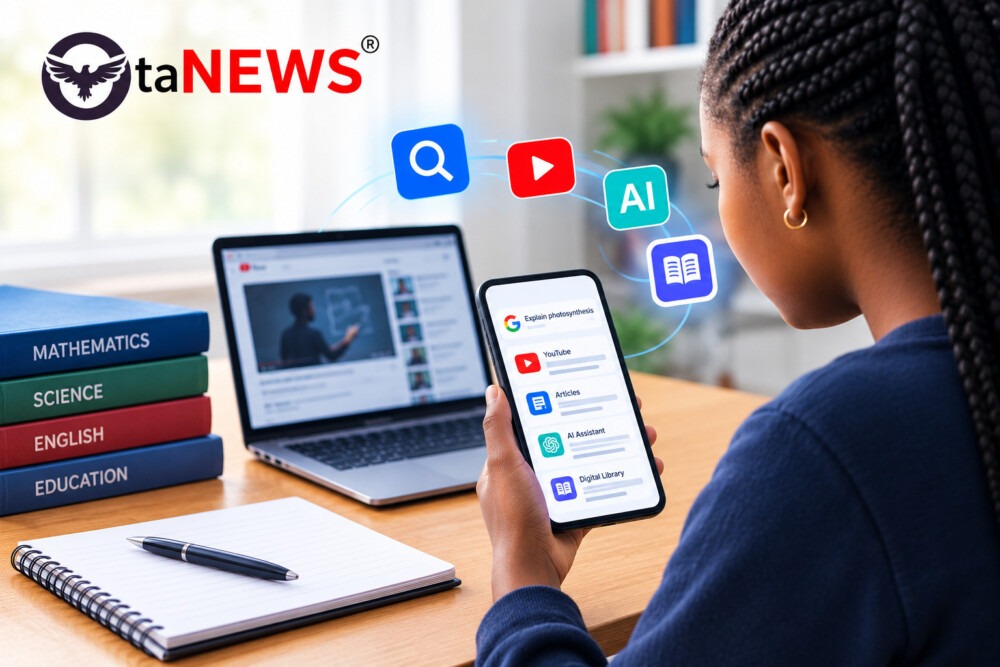
A student sits down to study, and instead of opening a textbook, she reaches for her phone.
She types a question into Google, within seconds, thousands of results appear. She opens a YouTube video, checks a blog, asks an AI tool to explain the topic and perhaps copies a few lines into her notes she finds the information but has she learned?
This is becoming an increasingly important question in Nigerian education as students gain access to more digital resources. Learning is no longer limited to what happens inside a classroom (where a teacher is considered a brain behind every disseminated information) or what can be found in a textbook. A smartphone can provide access to lectures, articles, videos, digital libraries and educational platforms from almost anywhere.
Nigeria itself is investing in digital learning. The Nigeria Learning Passport, supported by UNICEF and the Federal Ministry of Education, has expanded access to curriculum aligned digital learning resources. UNICEF reported that the platform had more than two million users in 2025, with thousands of learning resources available to learners.
The possibilities are encouraging, but there is a difference between having information and knowing what to do with it.
For many students, the internet has changed the meaning of research.
A question that once required a trip to the library can now be answered within minutes. Students can now watch an explanation of a difficult concept, download an article, search for definitions or use digital tools to organise their work.
Artificial intelligence has made this even easier a student struggling to understand a topic can ask an AI tool to explain it in simpler language. Another can use it to generate ideas for an assignment. Someone else can ask it to summarise a long article.
These tools can be useful.
Nigeria’s National Digital Learning Policy itself recognises the potential of artificial intelligence in digital learning, while also warning about over reliance on AI and the possible effect on students’ critical thinking and problem-solving abilities the problem, therefore, is not that students are searching for answers It begins when searching becomes a substitute for thinking.
Finding information online does not mean that the information is accurate.
A search result can lead to a credible academic source, but it can also lead to an outdated article, an anonymous blog, a misleading social media post or information generated without proper evidence.
A student who copies the first answer that appears on a search engine may complete an assignment without ever understanding the subject.
This is where information literacy becomes important.
Students need to know how to ask better questions, compare sources, identify reliable information, recognises misleading claims and use information responsibly.
UNESCO has described media and information literacy as increasingly important because people are now dealing with unprecedented flows of information and need the ability to verify and intelligently engage with what they encounter.
In other words, the ability to find information is only the beginning.
The rise of digital learning does not make libraries irrelevant.
If anything, it changes what students need from them.
The modern library is no longer simply a room filled with shelves libraries can now provide access to electronic books, academic journals, databases, institutional repositories and other digital resources.
They can also help students learn how to find and evaluate information.
The Federal Ministry of Education itself describes library services as important to education and research and recognises the role of libraries in providing information in both digital and traditional formats.
A student who knows how to search Google but does not know how to distinguish a reliable academic source from an unreliable one still has a gap, but guidance teaches people how to use that access well.
So, are Nigerian students really learning online? some certainly are.
Digital learning has created opportunities that would have been difficult to imagine for previous generations. A student can now learn from a teacher in another city, access educational materials from home and revisit a difficult lesson repeatedly.
UNICEF’s recent work with the Nigeria Learning Passport also shows that digital platforms can support learning beyond the classroom. In Sokoto State, for example, students have used the platform to study independently and access lessons outside traditional classroom settings.
But digital access alone cannot guarantee learning.
A student can spend three hours online and learn very little. Another can spend thirty minutes with the right resource and understand something that previously seemed impossible.
The difference is not always the amount of information available.
Sometimes, it is the ability to engage with that information.
We need to teach students how to learn, not only where to search. As technology becomes more deeply woven into education, Nigerian students will need more than internet access.
They will need curiosity.
They will need critical thinking.
They will need research skills.
They will need to question information rather than accept everything that appears on a screen.
And they will need to understand that AI, Google, YouTube and other digital tools are learning aids, not replacements for learning itself.
The goal should not be to return students to a world without technology.
It should be to raise students who can use technology without allowing technology to do all their thinking for them. Perhaps the real question is not whether Nigerian students are learning online.
It is whether, in a world where almost every answer is a search away, we are still teaching them how to think about the answers they find
.